
When catalog hardware won't meet your dimensional or performance requirements, we provide precision-machined custom profiles built to your exact blueprint.
Request a Custom Quote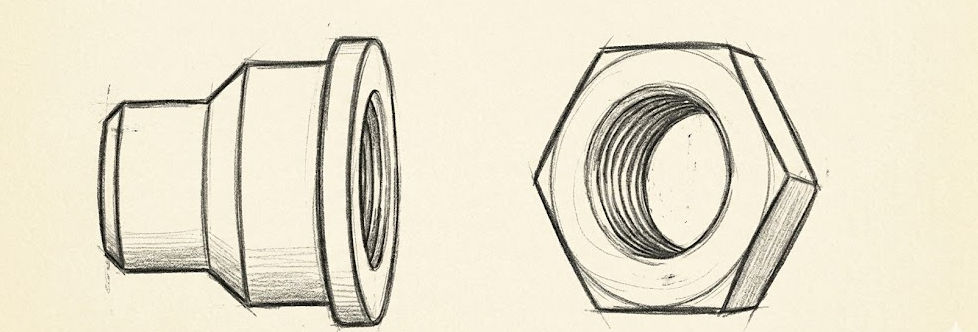
Not every fastener problem can be solved with a standard part. Geometry often requires specific tapers for self-centering, flanges for load distribution, or shoulders for assembly clearance. We bridge the gap between "standard" and "functional."
We recently delivered a specialized component designed for alignment and repeatability in a fluid system assembly:
A custom profile is only as reliable as its metallurgy. We machine parts in a variety of materials to balance strength, corrosion resistance, and thermal performance.
Maximum corrosion resistance for washdown, marine, and food-processing environments.
High strength and hardness ratings while maintaining excellent oxidation resistance.
Designed for high-heat applications, maintaining integrity up to 1300°F (704°C).
Cost-effective solutions for electrical conductivity or standard structural requirements.
In custom hardware, minor dimensions define assembly success. Whether your design requires a specific .075" flange thickness or a .350" shoulder length, our process ensures the part fits the application—not the other way around.
We work from finished prints or initial concepts to solve complex fastening challenges. Custom hardware doesn't have to be complicated; it just has to be intentional.
Submit your specs or blueprint. Our team will review your requirements and provide a quote for custom profile machining.
